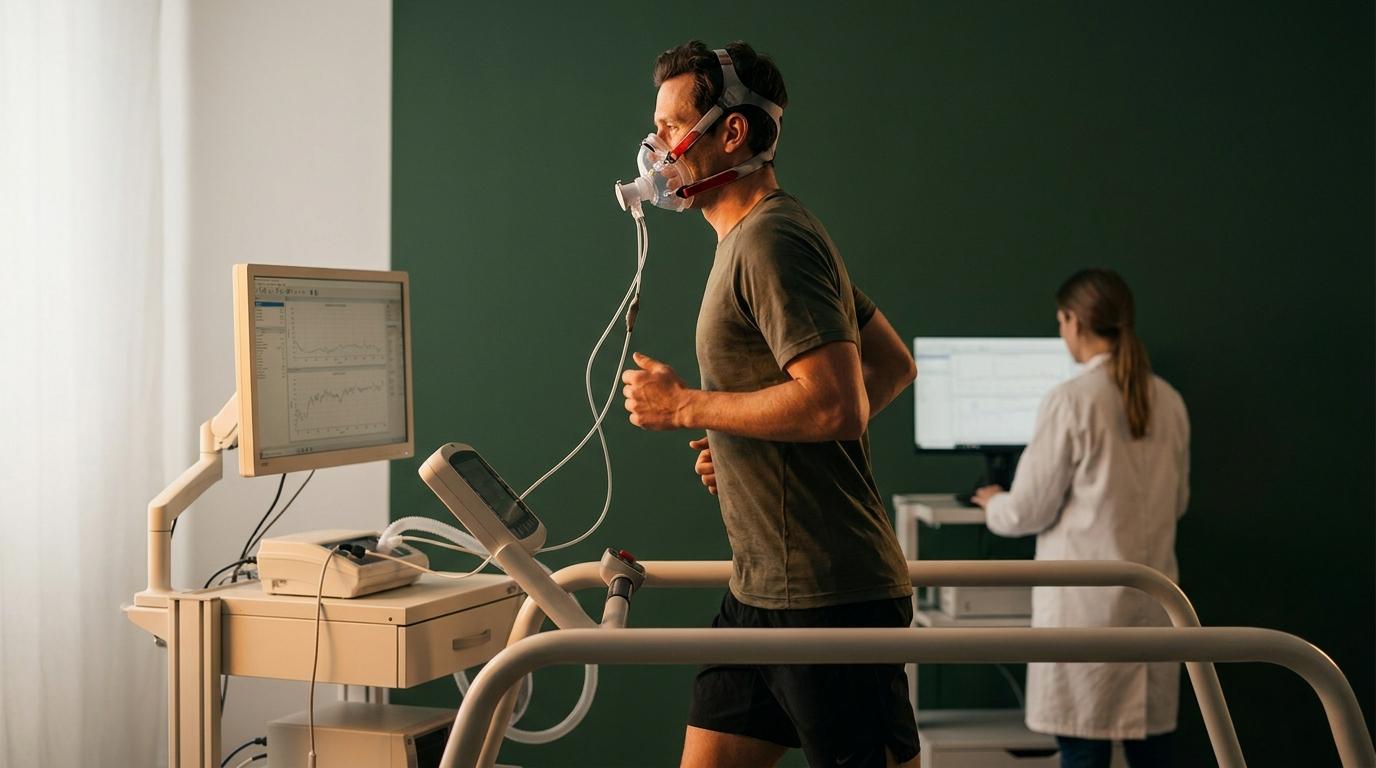
Zone 2 is the training intensity (60-70% of maximum heart rate) that most effectively activates mitochondrial biogenesis and fat oxidation. You can hold a conversation during the effort. You do not suffer. Yet the molecular mechanisms it activates are remarkably sophisticated, and their long-term effects on metabolic health exceed what most people imagine.
What Zone 2 means biologically
Zone 2 corresponds to an exercise intensity situated just below the first lactate threshold. In practice, this represents roughly 60 to 70 % of maximum heart rate. At this intensity, blood lactate remains stable, below 2 mmol/L, indicating that slow-twitch type I muscle fibers (the endurance fibers, rich in mitochondria) are performing most of the work without generating significant lactate accumulation.
This point is crucial. Lactate, long considered a simple metabolic waste product, is now recognized as a biological signal in its own right (PubMed ). Its stability in Zone 2 reflects a balance between production and clearance, a precise state reached neither at low intensity nor beyond the threshold. It is exactly this equilibrium that allows aerobic metabolic pathways to operate at full capacity.
The peak rate of fatty acid oxidation during exercise occurs around 64 % of VO₂max, an intensity that corresponds to Zone 2 for the majority of individuals.
The molecular cascade: AMPK, PGC-1α, and mitochondrial biogenesis
One of the best-documented mechanisms of endurance training involves the AMPK-PGC-1α pathway. During prolonged low-intensity exercise, the AMP/ATP ratio in muscle cells rises (a sign that available energy is declining), activating AMPK (AMP-activated protein kinase). This enzyme functions as a cellular energy sensor: it detects that the cell is consuming energy and triggers the necessary adaptations.
What distinguishes Zone 2 from other intensities is the duration over which this activation state is maintained. An hour of moderate-intensity running stimulates AMPK in a sustained manner, without neuromuscular fatigue prematurely interrupting the session.
AMPK directly activates PGC-1α (often called the "master regulator" of new mitochondria production) by chemically modifying it at two precise structural sites. This activation is essential. Without it, AMPK's metabolic effects in skeletal muscle are virtually nonexistent (PubMed ). Once activated, PGC-1α migrates to the cell nucleus and orchestrates the expression of hundreds of genes involved in mitochondrial biogenesis (the production of new mitochondria).
The result, after several weeks of regular training, is a measurable increase in mitochondrial density within muscle fibers. PGC-1α does not simply regulate the quantity of mitochondria; it also controls their quality, their network organization, and the mitophagy mechanisms (the selective recycling of failing mitochondria) that eliminate dysfunctional mitochondria (PubMed ). This is a fundamental distinction: Zone 2 training does not merely add mitochondria, it improves their intrinsic efficiency.
Fat oxidation: the metabolic advantage of Zone 2
One of the most valuable adaptations from Zone 2 training concerns lipid metabolism. At this intensity, skeletal muscle preferentially oxidizes fatty acids. Data from Achten et al. established that the peak of fat oxidation (FatMax, the intensity at which the body burns the most fat) occurs on average at 64 % of VO₂max, a value that closely corresponds to Zone 2 (PubMed ).
An untrained individual at this intensity relies more heavily on glucose even during low effort. After several months of regular Zone 2 training, that same intensity is covered with a much higher proportion of fatty acids. The muscle has learned to use a more abundant, energy-dense fuel, sparing glycogen stores for high-intensity efforts.
This is metabolic flexibility: the ability to efficiently switch between fats and sugars as energy sources, according to effort intensity and nutrient availability. A degraded metabolic flexibility profile is associated with insulin resistance and metabolic syndrome. Zone 2 training is, to date, one of the most effective means of restoring or developing this capacity.
The protocol: how to apply Zone 2 in practice
Implementing Zone 2 relies on simple physiological markers. The conversation test is the most accessible: at the right intensity, you can speak in complete sentences without becoming breathless, but you cannot sing. Exclusive nasal breathing is another reliable marker: if you are forced to open your mouth to breathe, intensity has exceeded Zone 2. In terms of heart rate, the 60 to 70 % of maximum heart rate range provides a reasonable starting point, though individual variability is real and justifies a personalized approach (PubMed ).
For mitochondrial adaptations to occur, training volume matters as much as intensity. Available data suggest a minimum of 45 to 90 minutes per session, repeated 3 to 4 times per week. Below 45 minutes, the metabolic stimulus remains suboptimal. Beyond 90 minutes, benefits continue to accumulate, but recovery becomes a limiting factor for most non-professional individuals.
The choice of activity is secondary. Running, cycling, swimming, rowing: what matters is mobilizing large muscle masses continuously at the target intensity. Load-bearing sports such as cycling or swimming reduce articular stress, allowing longer durations with reduced injury risk.
Integrating Zone 2 into a complete training week
Zone 2 does not operate in isolation. Longevity data converge toward a program integrating four pillars: strength (resistance training), high-intensity cardio (HIIT), flexibility and mobility, and active recovery. Zone 2 constitutes the aerobic foundation upon which the other three rest.
A coherent weekly framework alternates resistance training (3 days), cardio (3 days, with the majority in Zone 2), and active recovery (1 day). Cardio days can combine a short HIIT session (4 to 8 minutes of high-intensity intervals) followed by 25 to 40 minutes of Zone 2. This structure respects the polarized distribution that elite endurance athletes practice: roughly 80% of total volume at low intensity, 20% at high intensity.
A cohort study published in Circulation in 2022 established that the optimal longevity zone lies between 300 and 600 minutes of physical activity per week, with a combination of moderate and vigorous exercise associated with a 35 to 42% reduction in all-cause mortality (PubMed ). Zone 2 represents the most accessible way to reach this volume without accumulating excessive fatigue.
The Norwegian 4x4 protocol (4 minutes at 85-95% of maximum heart rate, 3 minutes of active recovery, repeated 4 times) produced a 22% increase in VO2max in individuals recovering from cardiovascular events (PubMed ). Inserting this type of session twice per week, alongside three to four Zone 2 sessions, creates a framework that simultaneously addresses mitochondrial biogenesis and anaerobic capacity.
Why Zone 2 is underestimated
The main reason for its neglect is cultural. An hour of conversational jogging appears less effective than a 20-minute HIIT session. Immediate performance metrics (calories burned during the session, peak heart rate) favor high intensities. But these metrics measure the wrong parameter.
Mitochondrial adaptations are structural adaptations. They build slowly, over weeks and months. They are not visible in the short term, but they determine the capacity of metabolism to function efficiently over decades. An individual with high mitochondrial density oxidizes fat more effectively at rest, regulates blood glucose more efficiently, and tolerates high-intensity efforts better because their aerobic base is stronger.
The final paradox is that Zone 2 also improves performance at high intensities. Elite endurance athletes dedicate an average of 80 % of their training volume to low intensities, a large proportion of which falls within Zone 2. This is not for lack of ambition: it is because the data, accumulated over decades, show that deep adaptations occur under this condition (PubMed ).
The mortality data reinforce this point. Low muscular strength in adolescence is associated with a 20 to 35% increased risk of premature death (PubMed ). But strength alone is not sufficient. VO2max, a direct indicator of aerobic capacity, is one of the most powerful predictors of longevity. Zone 2 is precisely the intensity that develops it durably, session after session, without overtraining risk.
The question that research continues to explore is broader: to what extent does mitochondrial health, built through decades of regular moderate-intensity effort, determine functional longevity? Longitudinal cohorts point in an unambiguous direction. The scientific chapter remains open, but its early conclusions are already actionable.
Frequently asked questions
References
- Brooks GA. Lactate as a fulcrum of metabolism. Redox Biol. 2020;35:101454 (PubMed ).
- Jäger S, Handschin C, St-Pierre J, Spiegelman BM. AMP-activated protein kinase (AMPK) action in skeletal muscle via direct phosphorylation of PGC-1alpha. Proc Natl Acad Sci U S A. 2007;104(29):12017-22 (PubMed ).
- Halling JF, Pilegaard H. PGC-1α-mediated regulation of mitochondrial function and physiological implications. Appl Physiol Nutr Metab. 2020;45(9):927-936 (PubMed ).
- Spaulding HR, Yan Z. AMPK and the Adaptation to Exercise. Annu Rev Physiol. 2022;84:209-227 (PubMed ).
- Achten J, Gleeson M, Jeukendrup AE. Determination of the exercise intensity that elicits maximal fat oxidation. Med Sci Sports Exerc. 2002;34(1):92-97 (PubMed ).
- Meixner B, Filipas L, Holmberg HC, Sperlich B. Zone 2 Intensity: A Critical Comparison of Individual Variability in Different Submaximal Exercise Intensity Boundaries. Transl Sports Med. 2025;2025:2008291 (PubMed ).
- Lee DC, Artero EG, Sui X, Blair SN. Mortality trends in the general population: the importance of cardiorespiratory fitness. J Psychopharmacol. 2010;24(4 Suppl):27-35 (PubMed ).
- Wisløff U, Støylen A, Loennechen JP, et al. Superior cardiovascular effect of aerobic interval training versus moderate continuous training in heart failure patients. Circulation. 2007;115(24):3086-3094 (PubMed ).
- Halling JF, Jessen H, Nøhr-Meldgaard J et al. PGC-1α regulates mitochondrial properties beyond biogenesis with aging and exercise training. Am J Physiol Endocrinol Metab. 2019;317(3):E513-E525 (PubMed ).
- Ortega FB, Silventoinen K, Tynelius P, Rasmussen F. Muscular strength in male adolescents and premature death: cohort study of one million participants. BMJ. 2012;345:e7279 (PubMed ).