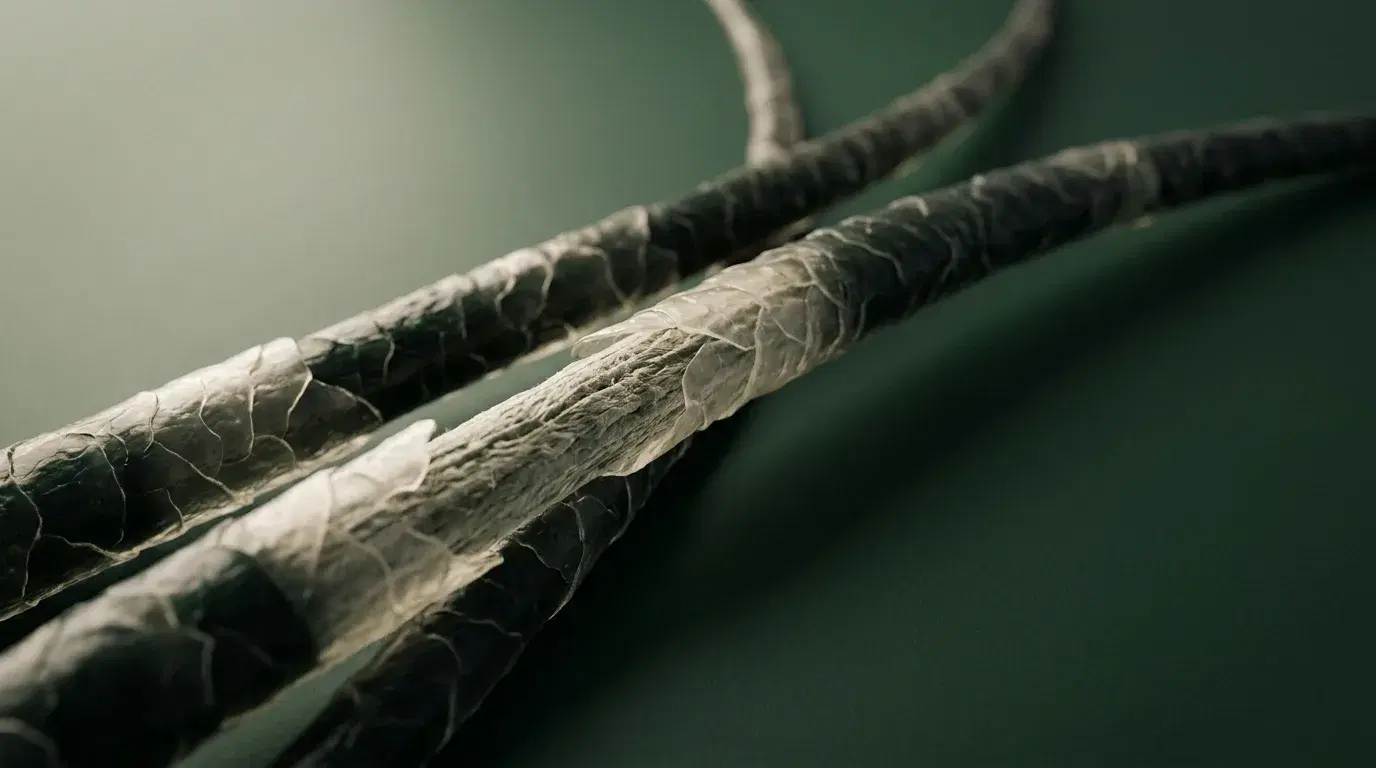
PP405 is a molecule applied to the scalp that wakes the dormant stem cells of the hair follicle by changing the way they produce their energy. The mechanism is a switch. A cell draws its energy from sugar, which it first breaks down into an intermediate fuel, pyruvate; that pyruvate is then carried into the mitochondrion, the cell's power plant, to be burned. PP405 shuts that door. Pyruvate then builds up and the cell converts it into lactate, the molecule a muscle also produces under effort, and it is that rise in lactate which serves as the wake-up signal. The founding observation dates from 2017 and came from the laboratories of Heather Christofk and William Lowry at the University of California, Los Angeles, who went on to found Pelage Pharmaceuticals to develop it (PubMed ).
The clinical program today rests on three facts: a Phase 2a trial completed on October 1, 2025, an efficacy figure that travelled around the world, and no Phase 3 registered to date. The gap between those three facts is the subject of this article.
The pyruvate switch
Hair follicle stem cells sit in the bulge, a swelling partway down the hair root, where they spend most of their time at rest. The UCLA team showed that they nonetheless produce their energy there by the short route, glycolysis, which breaks sugar down without passing through the mitochondrion, and that they make more lactate than the rest of the skin. In mice, deleting the enzyme that makes that lactate keeps follicles at rest; deleting instead the carrier that lets pyruvate into the mitochondrion speeds up their waking and the hair cycle. Applied to mouse skin, a molecule that blocks that carrier, UK-5099, produced visible growth within eight days (PubMed ).
This detour does not starve the cell of energy. By converting pyruvate into lactate in the cytoplasm, the body of the cell around the nucleus, it regenerates along the way a molecule that glycolysis needs in order to keep running, NAD+. The cell shifts toward a glycolytic way of working, and it is that state, more than the amount of energy available, which governs its exit from dormancy.
Pelage drew its molecule from chemistry work published in 2021, which reworked UK-5099 to make it more potent. The best compound in the series blocks the carrier at roughly a third of the concentration needed for the starting molecule (PubMed ). An extension of that work showed that shutting the pyruvate door restarts the hair cycle in mice made unresponsive by age, by repeated chemotherapy or by stress, with follicles of normal appearance under the microscope after thirty to forty days (PubMed ).
The relevance of this target in humans rests on an earlier observation. A balding scalp keeps its stem cells; what it has lost are the daughter cells those stem cells should give rise to in order to build a hair (PubMed ). The reserve is therefore intact, and it is the handover that no longer happens. PP405 bets that this handover can be restored without going through the hormonal route: the molecule lets dihydrotestosterone, the hormone that shrinks follicles in pattern baldness, act as before, and works on the metabolic state of the cell.
What the Phase 2a trial actually registered
Trial NCT06393452 enrolled 78 men and women aged 18 to 55 with androgenetic alopecia, the common hormone-driven pattern baldness, across eight US sites. Participants received at random either the active 0.05% gel or an identical gel containing no active ingredient, with neither they nor their doctors knowing who got which. One application a day for 28 days, follow-up extended to twelve weeks, then three months of extension in which everyone received the active product (study ).
Before it starts, every trial declares in the public registry what it will measure: those are its endpoints. This one declared two as primary, and both concern tolerability: the proportion of participants who had a side effect linked to the treatment, and the change in skin irritation at the point of application. The single secondary endpoint is how much product turns up in the blood. No regrowth measurement appears in the registry, at any rank, in any of the versions filed since April 2024.
The Phase 2a trial declared two tolerability measures and one measure of how much product reaches the blood. No measure of hair density or regrowth appears there.
The figure that travelled around the world comes from a company press release dated June 17, 2025. It states that at week eight, four weeks after the end of treatment, among men with a higher degree of hair loss, 31% of those treated with PP405 showed a greater than 20% increase in hair density, against 0% on placebo (press release ).
Reported that way, the figure is accurate. Its weight is another matter. It concerns a single-sex subgroup whose size is unknown; the point at which hair loss becomes "higher" is specified nowhere; the 20% threshold appears in no version of the registry. Nothing accompanies the percentage either to say how likely it is to be down to chance, or what range the true result would fall within. The June 2025 release called the response statistically significant, a term the later releases dropped.
Eleven months after the trial ended, the detailed results are still not filed on the registry. No peer-reviewed publication reports PP405's clinical data: a PubMed query returns only a July 2026 review article, which itself cites the press releases as its source (PubMed ).
The presentation given at the American Academy of Dermatology meeting on March 28, 2026 in Denver did not close that gap. It introduced a new metric, the Follicular Unit Count, which counts follicular units carrying at least one hair, and it showed before-and-after imaging. The release announcing it contains no new figure: no sample size, no percentage, no twelve-week data, no result in women (press release ).
The data pointing the other way
One published human result runs opposite to what is seen in mice. A team at the University of Manchester took real human scalp follicles and kept them alive in the laboratory, outside the body. When the carrier was blocked, the cells of the follicle stopped dividing, stem cells included. Reading which genes had switched on showed that the follicle had triggered its distress programme, the one a cell runs when it is short of resources and which puts division on hold; blocking that programme lifted the arrest (PubMed ).
Three caveats frame this result: the molecule tested is UK-5099 rather than PP405, the follicle was cultured outside the body and over a short period, and a dose that works well in a living organism can prove toxic on an isolated fragment. What stands is that the only published data on human follicles contradicts the expected direction, and that no human data on PP405 answers it.
The second caveat concerns cancer risk, and it is written into the biology of the target. The same carrier controls the stem cells of the intestine, where deleting it makes them proliferate more and increases their number (PubMed ). Waking stem cells is a therapeutic goal paired with a theoretical risk, since that is also what a nascent tumour does. The founding laboratories have published work that eases the concern, showing that the lactate route was not required for a skin cancer to develop in mice (PubMed ), but that work comes from the molecule's inventors. The most robust argument remains that no trace of the product was found in the blood, over four weeks and in 78 subjects.
Then there is magnitude. Finasteride was evaluated in 1,553 men over one year, counting the hairs in a 5.1 cm² area at the crown of the head, marked out and measured the same way before and after: 107 more hairs than placebo at one year, roughly 21 per square centimetre (PubMed ). That count was announced in advance, carried out by assessors who did not know who received what, and published; it has served as the yardstick since 1998. PP405 has communicated a responder rate at eight weeks, on an endpoint absent from the registry. The two measures do not compare, and the absence of published data is exactly what makes the difference impossible to settle.
Across 1,553 men followed for one year, the count announced in advance for a 5.1 cm² area at the crown showed 107 more hairs than placebo. PP405 has published no equivalent count.
Where the program stands on August 29, 2026
Pelage raised $120 million in a Series B on October 15, 2025, co-led by ARCH Venture Partners and GV. The release announced the launch in 2026 of a Phase 3 trial in androgenetic alopecia (press release ). The June 2025 release had already announced it, and the March 2026 release repeated it under the wording of late-stage studies.
As of August 29, 2026, no Phase 3 trial of PP405 is registered. A query of the ClinicalTrials.gov application programming interface, by sponsor and then by term, returns a single study: the completed Phase 2a. The European CTIS registry contains none. Phase 1 itself, designated PP405-001 in the Phase 2a summary, appears on neither of those two registries (study ).
A quieter milestone landed on July 19, 2026. The World Health Organization assigns every medicine a single universal generic name, the one that will one day appear on the packaging; it published the name "suvomipic", described as a blocker of the pyruvate carrier, with its chemical formula and its international registration number, 2260696-63-5 (WHO ). In public chemical structure databases, that number identifies JXL069, the compound from the 2021 chemistry work (PubChem ). Such a name is not given to a laboratory curiosity but to a molecule intended for market: it is a signal of intent. Neither the WHO nor Pelage states, however, that suvomipic designates PP405. The connection is plausible and undocumented.
The practical consequence of that publication is that the structure of the molecule becomes available to third parties. For a product applied to the skin, the molecule does only half the work: it is the liquid carrying it, the vehicle, that decides how much crosses the skin, how stable it stays, and what actually reaches the follicle. Individual experiments run with the molecule alone, outside the clinical formulation, therefore inform nothing in either direction.
No particular regulatory designation has been announced, no filing date, no price, no availability date. The approval timelines in circulation, ranging from 2027 to 2032 depending on the source, come from journalists and bloggers, never from the company. The complete Phase 2a dataset, promised for a future medical meeting, has not been presented.
What remains to be watched comes down to three datable events: the filing of the NCT06393452 results on the registry, the appearance of a Phase 3 registration number, and a first peer-reviewed publication. None of the three had occurred at the time this article was written.
What the follicle teaches the biology of aging
Stem cell exhaustion is one of the hallmarks of aging catalogued by López-Otín and colleagues, whose 2023 update sets reversibility through therapeutic intervention as a criterion for inclusion (PubMed ). The hair follicle is a favoured testing ground for that criterion, because it replays a complete regenerative cycle, because it is accessible without surgery, and because its dormancy is physiologically reversible.
Two mechanisms coexist in its aging, and they call for different responses. The first is a state: the stem cell is present and no longer activates, as in balding scalp. The second is a disappearance. As DNA damage accumulates, the protein that anchors stem cells to their niche degrades; the cells come loose, travel up toward the surface of the skin and are shed with dead skin cells, and the follicle shrinks for good (PubMed ). A metabolic lever can only act on the first.
Lactate, long treated as mere waste, changed status in 2019. A team showed that it attaches directly to the proteins around which DNA is coiled, altering which genes get read, across twenty-eight identified attachment points (PubMed ). The temptation to connect that mechanism to the activation of the follicle's stem cells is strong. No published work has done so. The bridge remains a hypothesis, and saying so is part of reading the file honestly.
At this stage, the PP405 program is a demonstration of mechanism paired with a promise of results. The biology is solid and published; the clinical data are neither. That imbalance describes the state of longevity medicine in 2026 fairly well, where scientific ambition travels faster than the counts, announced in advance, that would validate it. The day a count announced in advance is published, covering real hairs, the thick pigmented ones rather than fine down, and compared against the gel without active ingredient, it will carry more weight than every responder rate announced so far.
Frequently asked questions
References
- Flores A, Schell J, Krall AS, et al. Lactate dehydrogenase activity drives hair follicle stem cell activation. Nat Cell Biol. 2017;19(9):1017-1026. (PubMed )
- Liu X, Flores AA, Situ L, et al. Development of Novel Mitochondrial Pyruvate Carrier Inhibitors to Treat Hair Loss. J Med Chem. 2021;64(4):2046-2063. (PubMed )
- Flores A, Choi S, Hsu YC, Lowry WE. Inhibition of pyruvate oxidation as a versatile stimulator of the hair cycle in models of alopecia. Exp Dermatol. 2021;30(4):448-456. (PubMed )
- Garza LA, Yang CC, Zhao T, et al. Bald scalp in men with androgenetic alopecia retains hair follicle stem cells but lacks CD200-rich and CD34-positive hair follicle progenitor cells. J Clin Invest. 2011;121(2):613-622. (PubMed )
- Safety, Pharmacokinetics and Efficacy of PP405 in Adults With AGA. ClinicalTrials.gov. NCT06393452. (study )
- Pelage Pharmaceuticals. Pelage Pharmaceuticals Announces Positive Phase 2a Clinical Trial Results for PP405 in Regenerative Hair Loss Therapy. Press release, June 17, 2025. (press release )
- Agrawal A, Dreifus EM, Tosti A. Emerging pharmacotherapies for androgenetic alopecia. Expert Opin Pharmacother. 2026;27(10):929-939. (PubMed )
- Pelage Pharmaceuticals. Pelage Pharmaceuticals' PP405 and its Impact on Follicular Regeneration to be Presented at the American Academy of Dermatology (AAD) Annual Meeting 2026. Press release, March 18, 2026. (press release )
- Pye D, Scholey R, Ung S, et al. Activation of the integrated stress response in human hair follicles. PLoS One. 2024;19(6):e0303742. (PubMed )
- Schell JC, Wisidagama DR, Bensard C, et al. Control of intestinal stem cell function and proliferation by mitochondrial pyruvate metabolism. Nat Cell Biol. 2017;19(9):1027-1036. (PubMed )
- Flores A, Sandoval-Gonzalez S, Takahashi R, et al. Increased lactate dehydrogenase activity is dispensable in squamous carcinoma cells of origin. Nat Commun. 2019;10(1):91. (PubMed )
- Kaufman KD, Olsen EA, Whiting D, et al. Finasteride in the treatment of men with androgenetic alopecia. J Am Acad Dermatol. 1998;39(4 Pt 1):578-589. (PubMed )
- Pelage Pharmaceuticals. Pelage Pharmaceuticals Announces $120 Million Series B Financing to Advance Regenerative Medicine Treatments for Hair Loss. Press release, October 15, 2025. (press release )
- World Health Organization. International Nonproprietary Names for Pharmaceutical Substances (INN). Proposed INN: List 135. WHO Drug Information. 2026;40(2), "suvomipic" entry. (WHO )
- National Center for Biotechnology Information. PubChem Compound Summary for CID 137374808, JXL069. CAS 2260696-63-5. (PubChem )
- López-Otín C, Blasco MA, Partridge L, Serrano M, Kroemer G. Hallmarks of aging: An expanding universe. Cell. 2023;186(2):243-278. (PubMed )
- Matsumura H, Mohri Y, Binh NT, et al. Hair follicle aging is driven by transepidermal elimination of stem cells via COL17A1 proteolysis. Science. 2016;351(6273):aad4395. (PubMed )
- Zhang D, Tang Z, Huang H, et al. Metabolic regulation of gene expression by histone lactylation. Nature. 2019;574(7779):575-580. (PubMed )