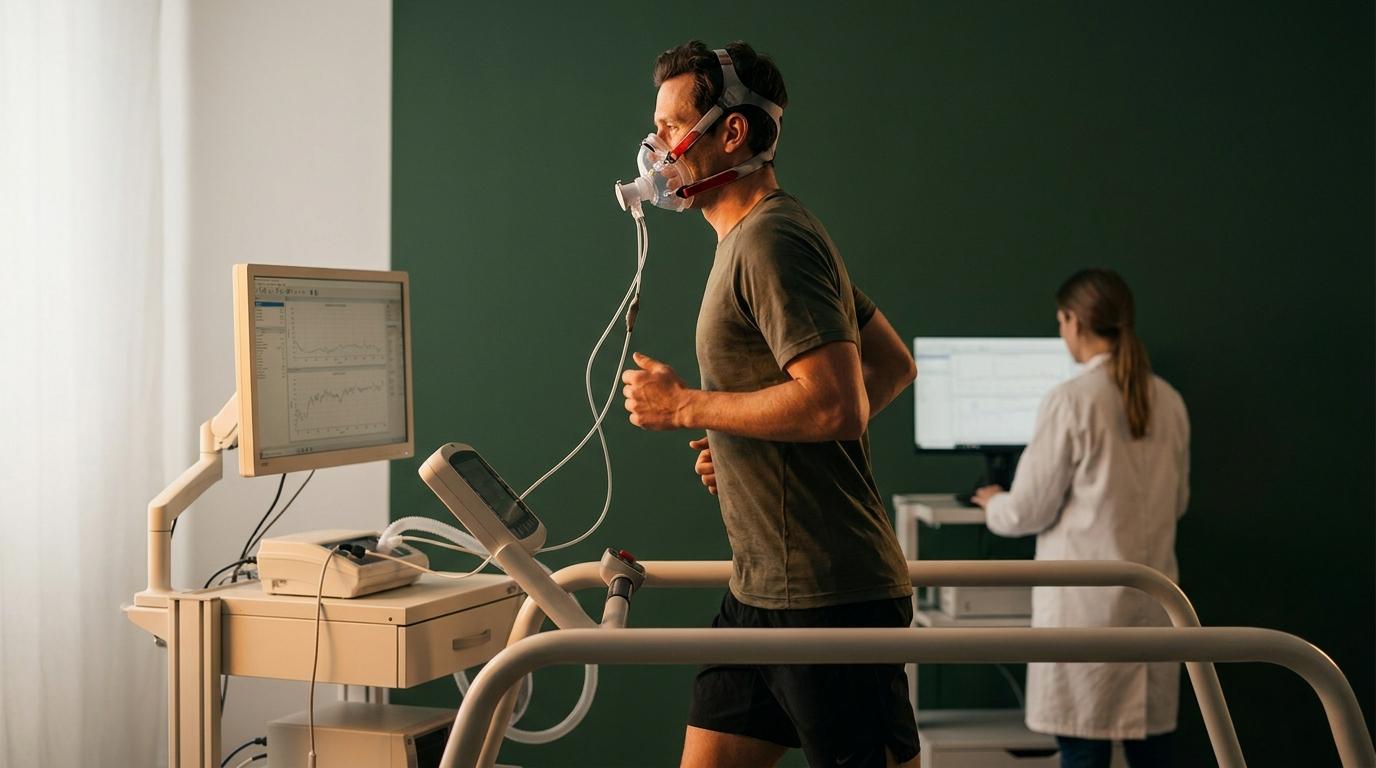
Grip strength is a stronger predictor of all-cause mortality than systolic blood pressure: skeletal muscle acts as an endocrine organ and handles most of the insulin-stimulated uptake of glucose, which makes it a metabolic pillar of longevity. In the PURE study, conducted on nearly 140,000 adults across seventeen countries, every 5 kg decrease in grip strength was associated with roughly a 16% increase in all-cause mortality (PubMed ). Muscle mass and strength shape glucose regulation, functional reserve, and the trajectory of aging, well beyond athletic performance. La Revue has already described endurance training and Zone 2; resistance work follows a distinct molecular logic, aimed at preserving the contractile tissue itself.
Strength as a trajectory predictor
What makes muscle unusual as a longevity marker is that it is simple to measure and predicts a great deal. A grip dynamometer, a chair-rise test, an estimate of lean mass: these functional indicators track the aging trajectory more faithfully than chronological age. In PURE, grip strength proved a better predictor of all-cause and cardiovascular mortality than systolic blood pressure, long regarded as a cornerstone of risk assessment (PubMed ).
This link is not confined to raw strength; the activity that builds it matters just as much. A meta-analysis of cohorts examining muscle-strengthening activities established a J-shaped association with mortality: the maximum benefit, a risk reduction on the order of 10 to 17%, appears at around 30 to 60 minutes per week, then fades beyond that (PubMed ). In other words, a modest but regular weekly dose is enough to move the curve, and this effect remains independent of aerobic activity.
That independence is the key point. Resistance work acts on its own determinant of longevity, the maintenance of contractile tissue and its function, where endurance builds aerobic capacity. Neglecting this pillar leaves an entire side of the aging trajectory without a stimulus.
Where you stand: grip strength by age and sex
Knowing what "normal" strength looks like is the missing piece. Dodds' British norms, built from nearly 50,000 people, provide reference grip-strength values (handheld dynamometer, best value) by age and sex (PubMed ). The categories below place a result relative to peers of the same age and sex: low (below the 25th centile), normal (25th to 75th centile), strong (75th to 90th) and very strong (above the 90th). They describe relative standing in the population, not a clinical grade.
Men (grip strength, in kg)
| Age | Low | Normal | Strong | Very strong |
|---|---|---|---|---|
| 30 | < 44 | 44-58 | 58-64 | > 64 |
| 40 | < 44 | 44-57 | 57-63 | > 63 |
| 50 | < 41 | 41-54 | 54-60 | > 60 |
| 60 | < 39 | 39-51 | 51-56 | > 56 |
| 70 | < 34 | 34-44 | 44-49 | > 49 |
| 80 | < 27 | 27-37 | 37-42 | > 42 |
Women (grip strength, in kg)
| Age | Low | Normal | Strong | Very strong |
|---|---|---|---|---|
| 30 | < 27 | 27-35 | 35-39 | > 39 |
| 40 | < 27 | 27-35 | 35-39 | > 39 |
| 50 | < 25 | 25-33 | 33-37 | > 37 |
| 60 | < 22 | 22-31 | 31-34 | > 34 |
| 70 | < 20 | 20-27 | 27-31 | > 31 |
| 80 | < 16 | 16-23 | 23-26 | > 26 |
Beneath these distributions lies a clinical screening threshold, independent of age. The European consensus sets low strength below 27 kg in men and 16 kg in women, values derived from these same British data (2.5 SD below peak) that warrant screening for age-related muscle loss (PubMed ). These figures inform a conversation with a health professional; they establish no diagnosis.
Muscle as a metabolic organ
Skeletal muscle is the main regulator of post-meal blood glucose. It represents the largest insulin-sensitive mass in the body and accounts for roughly 80% of insulin-stimulated glucose uptake (PubMed ). Each contraction also opens a glucose entry route that is partly independent of insulin, which explains why exercise lowers blood glucose even when insulin sensitivity is impaired.
Skeletal muscle accounts for roughly 80% of insulin-stimulated glucose uptake, making it the body's principal metabolic reservoir for blood glucose.
The practical consequence shows up on the markers. Meta-analyses of controlled trials show that a resistance program lowers HbA1c and insulin in people with type 2 diabetes, with the effect size increasing with training intensity (PubMed ). The more muscle mass is developed and used, the wider the window for glucose disposal. This is the mechanism captured, on a biological panel, by fasting glucose, HbA1c, insulin and the HOMA-IR index: windows onto metabolic health that muscle directly helps shape.
Muscle as an endocrine organ
With every contraction, muscle secretes chemical messengers called myokines, which travel to the liver, adipose tissue and brain. This discovery established muscle as a full-fledged endocrine organ (PubMed ). Interleukin-6 (IL-6) is its prototype: released in a spike during effort, it mobilizes glucose, transiently improves insulin sensitivity, and triggers a downstream anti-inflammatory cascade.
This reading may seem to contradict what La Revue writes elsewhere about IL-6. The distinction lies in kinetics and source.
This endocrine dialogue explains why the effect of training reaches far beyond muscle. Myokines take part in regulating systemic metabolism, linking contractile tissue to parameters as varied as blood glucose, fat storage and cognitive function. Trained muscle calibrates the whole terrain, well beyond its own mass.
The protein threshold
No mechanical stimulus builds tissue without substrate. Muscle protein synthesis responds to two signals: the mechanical tension of training and the availability of amino acids. Nutritionally, the reference meta-analysis places the plateau for lean mass gains at around 1.6 g of protein per kilogram of body weight per day in healthy adults who train with resistance (PubMed ).
Beyond roughly 1.6 g of protein per kilogram of body weight per day, additional intake no longer increases the lean-mass gains induced by resistance training in healthy adults.
This threshold is not universal. With age, anabolic resistance sets in: the same protein dose stimulates muscle synthesis less efficiently, a well-documented phenomenon that often calls for a higher, better-distributed intake across the day (PubMed ). The molecular detail of this signaling, around leucine and the mTOR pathway, is covered in a dedicated decoding, as is the energetic role of creatine. The protocol itself comes down to two actionable variables: a regular resistance stimulus and a protein intake matched to age and body weight.
A terrain to monitor, not to manage
Resistance training builds capital; biology lets you track how it evolves. Several markers on a complete panel give an indirect reading of the muscular and metabolic terrain. The glucose-disposal indicators (fasting glucose, HbA1c, insulin, HOMA-IR) reflect the muscle's capacity to absorb blood sugar. Albumin, the most abundant plasma protein, informs on overall protein status, provided it is cross-read with an inflammatory marker such as hs-CRP to interpret it correctly.
The vocabulary deserves precision. Age-related loss of muscle mass and strength is the subject of a European consensus definition, which characterizes it through thresholds of muscle strength, quantity and performance (PubMed ). That framework serves to describe a biological phenomenon, not to designate a pathology that a formula would correct. The distinction is central to Singular's positioning: read the terrain, document it over time, and nutritionally support what training builds.
One question the research keeps refining remains: to what extent does muscular reserve, accumulated decade after decade, determine not only lifespan but healthspan? The cohorts converge on a clear answer. Muscle is the only organ we can deliberately enlarge, and that plasticity makes it one of the few longevity levers that stays entirely in our hands.
Frequently asked questions
References
- Leong DP, Teo KK, Rangarajan S, et al. Prognostic value of grip strength: findings from the Prospective Urban Rural Epidemiology (PURE) study. Lancet. 2015;386(9990):266-273 (PubMed ).
- Momma H, Kawakami R, Honda T, Sawada SS. Muscle-strengthening activities are associated with lower risk and mortality in major non-communicable diseases: a systematic review and meta-analysis of cohort studies. Br J Sports Med. 2022;56(13):755-763 (PubMed ).
- Dodds RM, Syddall HE, Cooper R, et al. Grip strength across the life course: normative data from twelve British studies. PLoS One. 2014;9(12):e113637 (PubMed ).
- Cruz-Jentoft AJ, Bahat G, Bauer J, et al. Sarcopenia: revised European consensus on definition and diagnosis. Age Ageing. 2019;48(1):16-31 (PubMed ).
- DeFronzo RA, Tripathy D. Skeletal muscle insulin resistance is the primary defect in type 2 diabetes. Diabetes Care. 2009;32 Suppl 2:S157-S163 (PubMed ).
- Liu Y, Ye W, Chen Q, Zhang Y, Kuo CH, Korivi M. Resistance Exercise Intensity is Correlated with Attenuation of HbA1c and Insulin in Patients with Type 2 Diabetes: A Systematic Review and Meta-Analysis. Int J Environ Res Public Health. 2019;16(1):140 (PubMed ).
- Pedersen BK, Febbraio MA. Muscle as an endocrine organ: focus on muscle-derived interleukin-6. Physiol Rev. 2008;88(4):1379-1406 (PubMed ).
- Morton RW, Murphy KT, McKellar SR, et al. A systematic review, meta-analysis and meta-regression of the effect of protein supplementation on resistance training-induced gains in muscle mass and strength in healthy adults. Br J Sports Med. 2018;52(6):376-384 (PubMed ).
- Burd NA, Gorissen SH, van Loon LJC. Anabolic resistance of muscle protein synthesis with aging. Exerc Sport Sci Rev. 2013;41(3):169-173 (PubMed ).