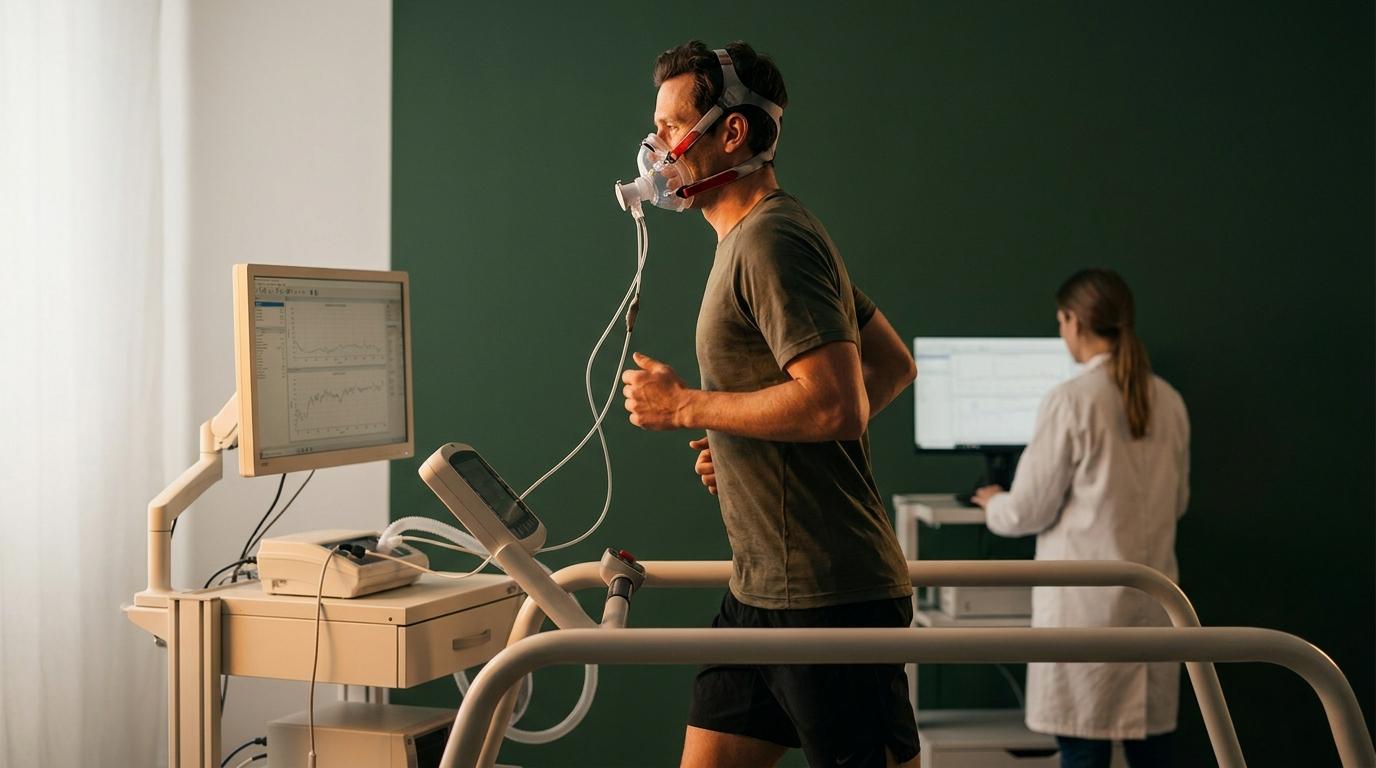
VO2max, or maximal oxygen uptake, is the most robust predictor of all-cause mortality identified by exercise physiology. In a cohort of 122,007 adults followed for more than eight years, low cardiorespiratory fitness carried a risk of death greater than smoking, type 2 diabetes or coronary artery disease (PubMed ). The least fit had roughly five times the mortality risk of the fittest, and the benefit showed no ceiling: the highest fitness levels remained associated with the best survival.
This finding moves VO2max out of the register of athletic performance and into that of major prognostic markers. It combines three properties rarely found in a single parameter: it is measured objectively, it is modifiable through training, and its association with prognosis is graded. That population association does not, by itself, quantify the causal benefit of a given individual gain.
A stronger predictor than classic risk factors
The relationship between aerobic capacity and mortality is quantitative and dose-dependent. A meta-analysis pooling 33 studies and 102,980 participants established that each 1-MET increment (metabolic equivalent, or 3.5 mL of oxygen per kilogram per minute) is associated with roughly 13% lower all-cause mortality and 15% fewer cardiovascular events (PubMed ). Individuals below 7.9 METs had a 70% higher risk of death than those above 10.9 METs.
Difference in all-cause mortality risk associated with each additional MET of observed cardiorespiratory fitness, per a meta-analysis of 102,980 participants; this is not a guaranteed causal effect of one MET gained by an individual.
This relationship is not confined to clinical populations. In a cohort of 4,137 apparently healthy adults whose VO2max was measured directly by respiratory gas analysis, each additional MET was associated with 11.6% lower all-cause mortality over nearly twenty-four years of follow-up (PubMed ). The observation is old and reproducible: as early as 1989, the Aerobics Center Longitudinal Study showed, in more than 13,000 healthy men and women, that all-cause mortality declined continuously from the least-fit quintile to the fittest, independently of smoking, cholesterol and blood pressure (PubMed ).
The effect can also be read in years of life. The 46-year follow-up of the Copenhagen Male Study associated high midlife cardiorespiratory fitness with a mean gain of 4.9 years of life expectancy compared with below-normal fitness, each additional VO2max unit corresponding to about 45 days of longevity (PubMed ).
These convergences led the American Heart Association to recommend, in 2016, assessing cardiorespiratory fitness as a clinical vital sign in its own right, on a par with blood pressure (PubMed ). One objection deserves to be raised. Some of the least-fit are so because an undetected illness lowers their capacity and raises their mortality, a form of reverse causation. The gradient that persists in cohorts of healthy individuals after early deaths are excluded weakens that explanation, without turning an observational association into an estimate of the causal benefit each individual would obtain by increasing VO2max.
What VO2max actually measures
VO2max quantifies the maximal rate of oxygen the body can extract from air, transport and consume during exercise. It integrates an entire physiological chain known as the oxygen cascade: pulmonary ventilation, the blood's oxygen-carrying capacity, cardiac output, and the density of the mitochondria that consume that oxygen in muscle.
Two terms dominate the equation. The first is maximal cardiac output, that is, the volume of blood the heart ejects per minute at peak effort. The second is the arteriovenous oxygen difference, the gap in oxygen content between the blood entering the muscle and the blood leaving it. A high VO2max reflects a heart that pumps a large volume and densely mitochondrial muscle that extracts most of it.
This is why VO2max summarises, in a single number, the functional state of several systems at once: heart, lungs, vascular network and mitochondrial muscle mass. Its decline more often signals a systemic decline than an isolated organ failure, which partly explains its broad prognostic value.
VO2max is expressed in millilitres of oxygen per kilogram per minute (mL/kg/min), or in METs, each MET worth 3.5 mL/kg/min. A VO2max of 35 mL/kg/min thus corresponds to 10 METs. Values vary widely with age, sex and training, from roughly 20 to 25 mL/kg/min in a sedentary adult up to more than 80 in an elite endurance athlete.
How to measure it: from the exercise test to the wearable
The reference measurement is a graded exercise test with respiratory gas analysis (cardiopulmonary exercise test, or CPET). Performed on a treadmill or bike with a mask on the face, it directly measures the oxygen consumed and the carbon dioxide expelled to the point of exhaustion. It is the only method that measures VO2max rather than estimating it, and it remains the recognised gold standard for assessing it (PubMed ).
In routine clinical practice, VO2max is most often estimated from a standard exercise test: the speed and incline reached on the treadmill allow METs to be calculated without measuring gases. This is the estimate that most large prognostic cohorts used.
Field tests offer an accessible alternative. The Cooper test (distance covered in 12 minutes), the 1.5-mile run test, or submaximal walking tests estimate VO2max from performance. Their margin of error is wider. They can document change when the same test and protocol are repeated under comparable conditions and the difference exceeds repeatability; they are not interchangeable with direct measurement.
Wearables now estimate VO2max from the relationship between heart rate and pace during running. Their validity is fair at the population level and more approximate at the individual level. A series obtained with the same device under similar conditions can provide a tracking signal, but the displayed trend remains subject to the algorithm, protocol, and repeatability; by itself, it does not prove physiological progress.
How to improve it: the leverage of intensity
VO2max is one of the physiological parameters most modifiable by training. A meta-analysis of 723 participants observed mean gains of 4.9 mL/kg/min with continuous endurance and 5.5 mL/kg/min with high-intensity intervals, over programmes lasting a few weeks to a few months (PubMed ). Relative to an average baseline of 40.8 mL/kg/min, that represents roughly 12 to 14%; these means are neither universal individual kinetics nor a universal delta.
Mean order of magnitude observed in a meta-analysis of continuous-endurance or interval programs in healthy adults; individual response and timing vary.
Both modalities work, with a slight edge for intervals: the same meta-analysis credits interval work with an additional benefit of 1.2 mL/kg/min over continuous endurance. A second meta-analysis, covering 334 subjects, confirms that interval training raises VO2max by 0.51 litres per minute on average, with longer intervals producing the largest gains (PubMed ).
The best-documented protocol combines the two intensities in a polarised distribution: a broad base of low-intensity endurance (Zone 2, below the lactate threshold) and one to two weekly sessions of near-maximal intervals. The Norwegian 4x4 format (four blocks of four minutes at 85-95% of maximal heart rate, separated by three minutes of active recovery) is among the most effective stimuli for VO2max. The mitochondrial mechanism of this aerobic base is detailed in our article on Zone 2 training.
A point of method matters as much as the choice of sessions: progression and volume. High-intensity intervals are demanding and lend themselves poorly to daily accumulation; it is the endurance base that carries the volume and allows recovery. Two interval sessions a week, grafted onto three to four Zone 2 outings, are enough to establish durable progress in most adults.
Trainability varies from one individual to another, partly for genetic reasons, but the modifiable component remains large at any age. Sedentary adults and older people improve, sometimes more in relative terms than already-trained subjects, because their starting margin is wider.
The metabolic terrain that accompanies aerobic capacity
No blood panel measures VO2max directly, since it is not a blood parameter. The aerobic training that raises it, however, deeply reshapes the metabolic terrain that blood does reveal. Insulin sensitivity improves, which HbA1c and HOMA-IR reflect (an index of insulin resistance calculated from fasting glucose and insulin). The lipid profile reorganises, with a rise in HDL and a fall in triglycerides and often in apolipoprotein B (ApoB, the count of atherogenic lipid particles). Low-grade inflammation recedes, which hs-CRP (high-sensitivity C-reactive protein) measures.
Aerobic capacity also depends on the first link of the oxygen cascade: blood transport. Haemoglobin, and therefore iron status, determines the amount of oxygen delivered to the muscles during effort. A lowered iron status, readable on ferritin, weighs on aerobic performance well before any clinical sign.
A reserve built over time
VO2max holds a singular place among longevity levers. It condenses the state of several systems, is measured objectively, and responds to training in a predictable way. Its prognostic value rests on an aerobic reserve built over years, more than on a momentary peak of fitness.
That reserve determines the slope of functional decline with age. The higher the capacity at forty, the later the threshold arrives at which climbing a flight of stairs or carrying groceries mobilises most of the resources available. Aerobic capacity declines naturally across the decades, the faster the lower the starting reserve, which gives early training a leverage effect on late-life independence.
Research continues to refine the strictly causal share of the association, but its direction has been constant across three decades of independent cohorts. For anyone looking for a single target to work on, aerobic capacity probably offers the best ratio between documented effort and measured benefit.
Frequently asked questions
References
- Mandsager K, et al. Association of Cardiorespiratory Fitness With Long-term Mortality Among Adults Undergoing Exercise Treadmill Testing. JAMA Netw Open. 2018;1(6):e183605 (PubMed ).
- Kodama S, et al. Cardiorespiratory fitness as a quantitative predictor of all-cause mortality and cardiovascular events in healthy men and women: a meta-analysis. JAMA. 2009;301(19):2024-2035 (PubMed ).
- Imboden MT, et al. Cardiorespiratory Fitness and Mortality in Healthy Men and Women. J Am Coll Cardiol. 2018;72(19):2283-2292 (PubMed ).
- Blair SN, et al. Physical fitness and all-cause mortality. A prospective study of healthy men and women. JAMA. 1989;262(17):2395-2401 (PubMed ).
- Clausen JSR, et al. Midlife Cardiorespiratory Fitness and the Long-Term Risk of Mortality: 46 Years of Follow-Up. J Am Coll Cardiol. 2018;72(9):987-995 (PubMed ).
- Ross R, et al. Importance of Assessing Cardiorespiratory Fitness in Clinical Practice: A Case for Fitness as a Clinical Vital Sign: A Scientific Statement From the American Heart Association. Circulation. 2016;134(24):e653-e699 (PubMed ).
- Harber MP, et al. Impact of Cardiorespiratory Fitness on All-Cause and Disease-Specific Mortality: Advances Since 2009. Prog Cardiovasc Dis. 2017;60(1):11-20 (PubMed ).
- Milanović Z, Sporiš G, Weston M. Effectiveness of High-Intensity Interval Training (HIT) and Continuous Endurance Training for VO2max Improvements: A Systematic Review and Meta-Analysis of Controlled Trials. Sports Med. 2015;45(10):1469-1481 (PubMed ).
- Bacon AP, Carter RE, Ogle EA, Joyner MJ. VO2max trainability and high intensity interval training in humans: a meta-analysis. PLoS One. 2013;8(9):e73182 (PubMed ).