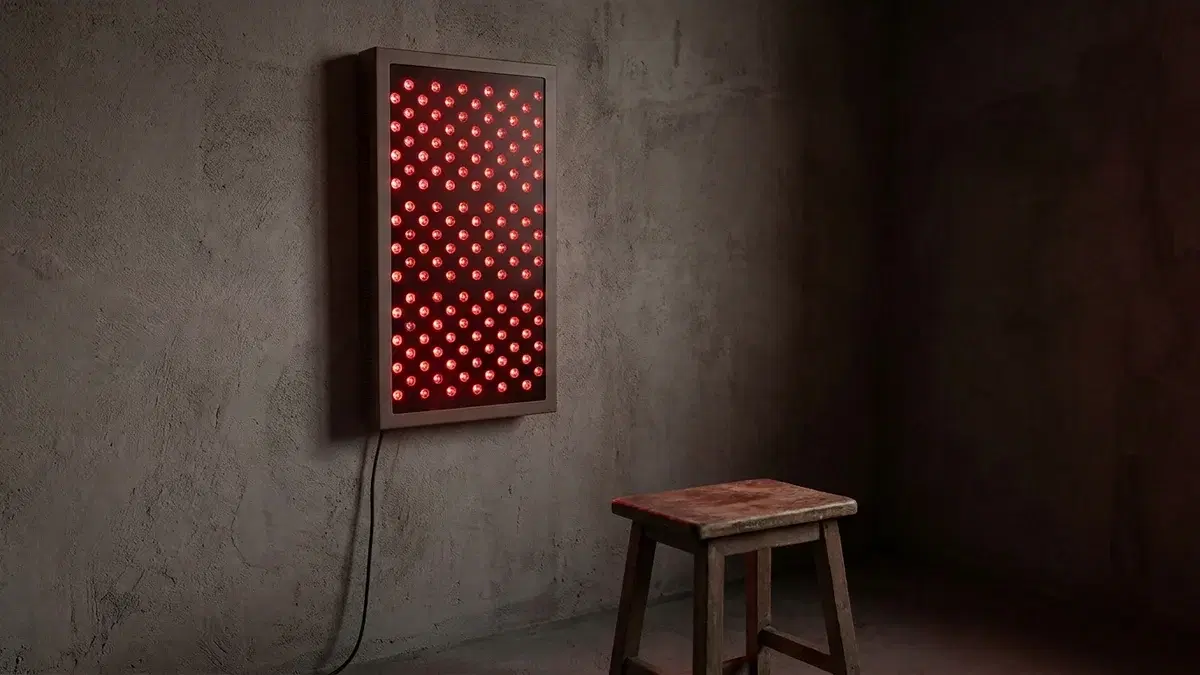
Photobiomodulation exposes tissue to red light between 630 and 670 nm, or near-infrared between 810 and 850 nm, which is absorbed by an enzyme of the mitochondrial respiratory chain and increases ATP production. The mechanism has been mapped for some fifteen years, and clinical trials cover skin, muscle and the hair follicle. Longevity appears in none of those trials: no protocol has run long enough to measure an effect on mortality. This gap between a solid mechanism and a fragmentary clinical translation governs everything one can reasonably expect from a panel of red diodes.
One enzyme, two spectral windows
Cytochrome c oxidase sits at the final position of the mitochondrial respiratory chain, just before water is formed and ATP is produced. This enzyme carries chromophores, chemical groups able to absorb light at specific wavelengths, and its two absorption windows fall in the red (600-700 nm) and in the near-infrared (800-850 nm) (PubMed ).
The dominant mechanistic hypothesis rests on a single reaction. Absorbed photons dissociate the nitric oxide that inhibits the enzyme by binding to its active site. Electron transport resumes, mitochondrial membrane potential rises, ATP production increases. Three secondary consequences follow: a transient burst of reactive oxygen species acting as a signal, a local release of nitric oxide, and an intracellular calcium flux. Downstream, the expression of genes tied to cell proliferation, collagen synthesis, wound healing and the local inflammatory response is modulated (PubMed ).
Three photonic modalities are routinely conflated, although they share neither spectrum nor mechanism. Photobiomodulation by LED panel or laser works on discrete wavelengths between 600 and 1000 nm, without ultraviolet and without perceptible heating. An infrared sauna heats tissue by radiation inside a cabin at 45-60°C, and its effect runs through heat, as detailed in our analysis of heat stress. Sunlight is a full spectrum including UVA, UVB, visible and thermal infrared, whose benefit-risk balance follows its own curve, covered in our article on sun exposure.
What the trials document, indication by indication
For skin, the most frequently cited trial enrolled 136 volunteers, 113 of them assigned to four treated groups and 23 serving as controls. Participants received two weekly sessions of red light, for a total of 30 sessions, at a dose normalised to roughly 9 J/cm² in the 611-650 nm window. Instrumental measurements showed a significant improvement in skin roughness by profilometry and in collagen density by ultrasound, confirmed by blinded photographic assessment (PubMed ). One secondary result deserves attention: the broad polychromatic spectrum offered no advantage over red light alone. The reference review of cutaneous applications confirms the convergence of data on wound healing and dermal matrix synthesis (PubMed ).
For muscle, the literature is abundant and uneven in quality. A systematic review gathered 39 randomised trials totalling 861 participants, 28 of which entered the meta-analysis. Results favour photobiomodulation on time to exhaustion, repetition count, isometric peak torque and blood lactate. The authors themselves rate the quality of evidence as very low to moderate, given small sample sizes and heterogeneous protocols (PubMed ). A meta-analysis of 24 trials conducted in athletes finds improved lower-limb strength when light is applied before exercise, together with reduced soreness, creatine kinase and interleukin 6. Its authors conclude that the effect has yet to be formally established (PubMed ).
For hair, the case is sharper. A double-blind randomised trial enrolled 44 men with androgenetic alopecia, fitted with a 655 nm helmet combining 21 laser diodes and 30 LEDs, in 25-minute sessions every other day for 16 weeks. The placebo group wore an identical device fitted with incandescent red bulbs. Blinded photographic counting measured a 39% increase in hair density compared with placebo, reduced to 35% after excluding one participant with an atypical baseline count (PubMed ).
Increase in hair count in the transition zone, measured blind against placebo in 41 men fitted with a 655 nm LED helmet, every other day for 16 weeks.
For the brain, caution is warranted. The field exists and is progressing, but the available synthesis remains a narrative review, a format that surveys the work without aggregating it statistically or weighting its risk of bias (PubMed ). No meta-analysis of randomised trials currently supports a cognitive application at home.
What all this work has in common fits in one sentence: it runs for 12 to 16 weeks and measures local endpoints. None follows a population for twenty years, none measures mortality or chronic disease incidence. Placing photobiomodulation on the same rank as the Finnish sauna, which has a prospective cohort spanning more than two decades, is an error of evidence level.
The dose decides, and overdosing is the common trap
Fifty years after the first studies, the discipline still has no consensus on its own parameters. Some groups recommend a power density below 100 mW/cm² and an energy density of 4 to 10 J/cm² at the target tissue. Others advocate up to 50 J/cm² at the surface. The most systematic review of the question plotted energy density against power density across the published record, and draws two lessons from it. Mitochondria-rich tissue (muscle, brain, heart, nerve) responds to lower doses than tissue containing fewer mitochondria (skin, tendon, cartilage). More importantly, within those models with high mitochondrial activity, trials that showed no effect more often reflected overdosing than underdosing (PubMed ).
Range of doses advocated in the literature at the tissue or at its surface, for want of a dosimetric convention. That spread explains a substantial share of the contradictory results.
This observation follows from an established property of photobiomodulation: its dose-response relationship is biphasic, shaped like a bell curve. Too little light produces nothing. Too much light inhibits the response instead of amplifying it (PubMed ). The logic is that of hormesis, familiar to anyone who practises sauna or exercise: the useful window is narrow and bounded on both sides.
The commercial corollary is direct. The race for irradiance that structures many manufacturers' pitch optimises the wrong parameter. Doses associated with positive results in the muscle meta-analysis ranged from 20 to 60 joules for small muscle groups and from 60 to 300 joules for large ones, with a maximum output of 200 mW per diode. These orders of magnitude are modest, and a device sold on its peak power invites exceeding them.
The defensible protocol
A panel combining both absorption windows, meaning 630-670 nm and 810-850 nm, covers most of what the literature has tested. Useful sessions run 10 to 20 minutes, at a distance of 15 to 30 centimetres, on bare skin: a cream, a garment or make-up absorbs a significant fraction of the radiation. Thermal sensation offers a simple marker. Perceptible heat signals far-infrared radiation, which belongs to heating rather than to photobiomodulation.
Daily use remains possible in healthy adults: the trials cited here report no adverse effects. After the dose, consistency is the most decisive parameter: trials that produced measurable results relied on 30 to 60 sessions spread over 12 to 16 weeks. Episodic practice has never been tested, and nothing warrants expecting anything from it.
This case awaits a convention rather than one more study. As long as each team publishes results with its own combination of wavelength, irradiance, distance and duration, meta-analyses will keep aggregating non-comparable protocols and producing confidence intervals too wide to decide on. Standardised dosimetry, reported at the target tissue rather than at the diode output, would turn photobiomodulation from a set of scattered signals into a calibratable lever. In the meantime, it holds an honest place in a longevity routine: accessible, well tolerated, documented on local effects, and several ranks below physical activity and sleep.
Frequently asked questions
References
- de Freitas LF, Hamblin MR. Proposed Mechanisms of Photobiomodulation or Low-Level Light Therapy. IEEE J Sel Top Quantum Electron. 2016;22(3):7000417 (PubMed ).
- Hamblin MR. Mechanisms and applications of the anti-inflammatory effects of photobiomodulation. AIMS Biophys. 2017;4(3):337-361 (PubMed ).
- Wunsch A, Matuschka K. A controlled trial to determine the efficacy of red and near-infrared light treatment in patient satisfaction, reduction of fine lines, wrinkles, skin roughness, and intradermal collagen density increase. Photomed Laser Surg. 2014;32(2):93-100 (PubMed ).
- Avci P, Gupta A, Sadasivam M, et al. Low-level laser (light) therapy (LLLT) in skin: stimulating, healing, restoring. Semin Cutan Med Surg. 2013;32(1):41-52 (PubMed ).
- Vanin AA, Verhagen E, Barboza SD, et al. Photobiomodulation therapy for the improvement of muscular performance and reduction of muscular fatigue associated with exercise in healthy people: a systematic review and meta-analysis. Lasers Med Sci. 2018;33(1):181-214 (PubMed ).
- Luo WT, Lee CJ, Tam KW, et al. Effects of Low-Level Laser Therapy on Muscular Performance and Soreness Recovery in Athletes: A Meta-analysis of Randomized Controlled Trials. Sports Health. 2022;14(5):687-693 (PubMed ).
- Lanzafame RJ, Blanche RR, Bodian AB, et al. The growth of human scalp hair mediated by visible red light laser and LED sources in males. Lasers Surg Med. 2013;45(8):487-495 (PubMed ).
- Salehpour F, Mahmoudi J, Kamari F, et al. Brain Photobiomodulation Therapy: a Narrative Review. Mol Neurobiol. 2018;55(8):6601-6636 (PubMed ).
- Zein R, Selting W, Hamblin MR. Review of light parameters and photobiomodulation efficacy: dive into complexity. J Biomed Opt. 2018;23(12):1-17 (PubMed ).
- Huang YY, Chen AC, Carroll JD, et al. Biphasic dose response in low level light therapy. Dose Response. 2009;7(4):358-383 (PubMed ).